How Far in Advance Should You Plan a Hackathon?
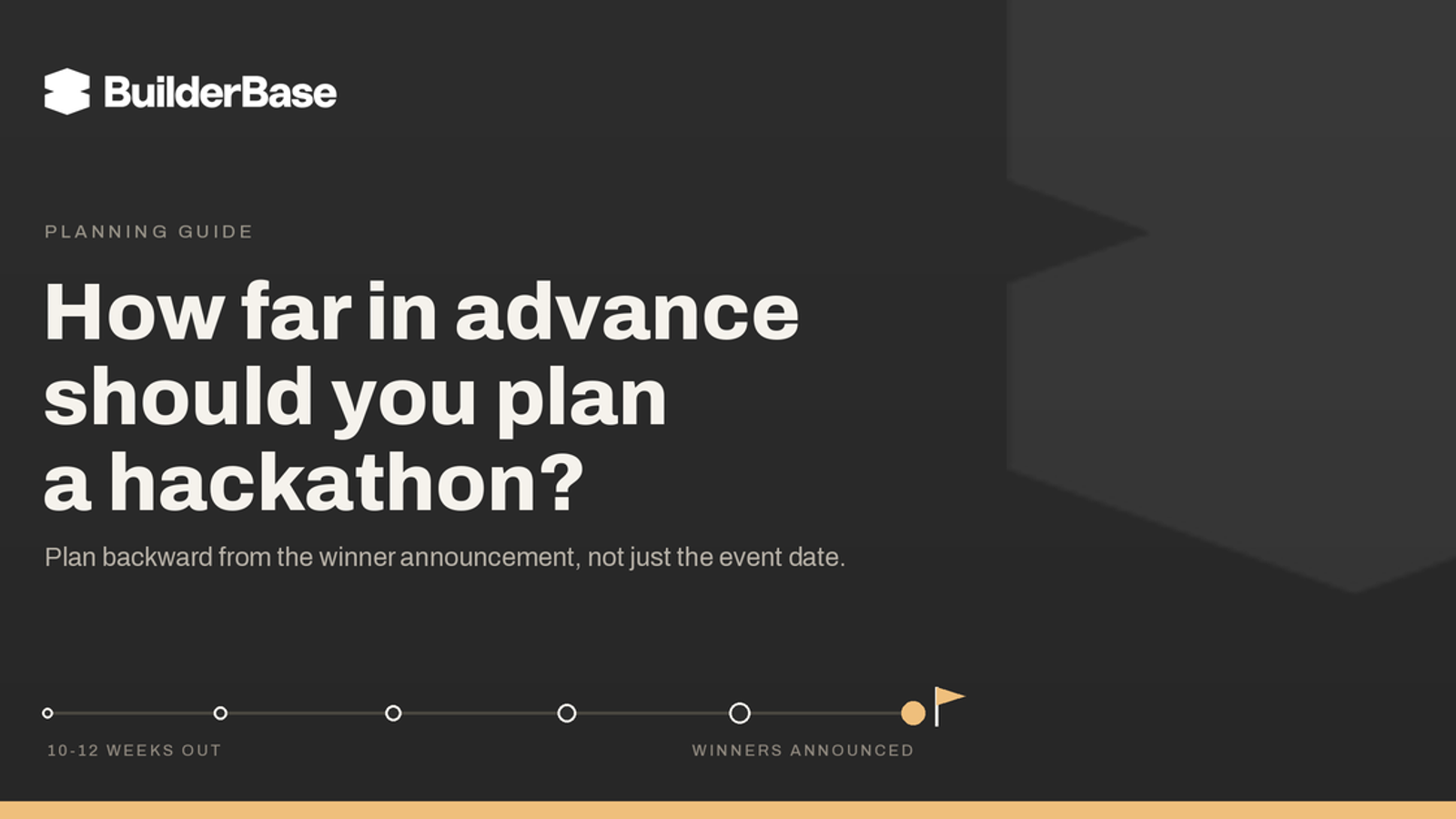
Plan a hackathon backward from the winner announcement, not only from the event date. Before you open applications, lock the program goal, participant rules, submission requirements, owners, and major dates. For a public online build program, Devpost recommends a six-to-eight-week registration and submission period, a one-to-two-week judging period, and a short winner-announcement buffer.
That does not mean every hackathon takes the same number of weeks. A 24-hour university event, a six-week corporate challenge, and a global hybrid program need different calendars. The useful planning method is to give every handoff its own deadline and owner before participants enter the system.
Start with the final promise
The planning clock ends when you have completed what participants were promised, not when the venue closes or submissions lock.
For an independently organized hackathon, the organizer remains responsible for the rules, judging, winner selection, announcements, prizes, and participant communication. Devpost makes that ownership explicit, even when its platform handles registration or submissions.
Write down these end states first:
- winners announced by a specific date;
- prizes or benefits delivered by a named owner;
- judges finished and conflicts resolved;
- sponsors received the agreed evidence;
- participants know where projects and results live;
- the organizer has attendance, submission, judging, and feedback data for the final report.
Now work backward. The winner announcement requires a completed judging process. Judging requires eligible, reviewable submissions. Submissions require participants who understood the brief, formed teams, accessed the right tools, and received support. That chain is the real timeline.
A practical planning baseline
The table below is a starting model for an event with public applications, several stakeholder groups, and a live build period. Compress or extend it based on event length, procurement, venue, geography, and participant volume.
Phase
When to start
What must be true before you move on
Program design
10–12 weeks before the event
Goal, audience, format, budget owner, challenge, eligibility, submission, judging, prizes, and success metrics are defined.
Public launch
8–10 weeks before the event
Event page, support channel, application form, privacy/consent language, sponsor route, and core dates are live.
Applications and preparation
6–8 weeks before the deadline
Participant intake, screening, team formation, mentor recruitment, challenge materials, and communications have clear owners.
Operational lock
Final 2 weeks
Participant list, teams, mentors, judges, schedule, access, accessibility needs, fallback routes, and escalation owners are confirmed.
Event and submission
Event window
Check-in, help requests, team changes, mentor activity, submissions, and deadline exceptions are recorded in one operating view.
Judging and follow-through
After submissions close
Eligibility review, judging, conflicts, winners, announcements, prizes, sponsor reporting, and participant follow-up are completed.
The point is not to obey a 12-week rule. It is to expose dependencies early. If your venue contract takes eight weeks, or legal review takes a month, the schedule must start sooner. If the event is internal and every participant is already known, the launch phase can be shorter.
Phase 1: define the program before promoting it
The fastest way to create a late-event crisis is to market an event while the core rules are still moving.
Devpost's planning guidance recommends defining the purpose, theme, requirements, dates, and prizes before going deep on website copy or promotion. Turn those categories into decisions:
- What result is the organization trying to produce?
- Who may participate, and who may not?
- What must a valid submission include?
- What data, software, facilities, or mentors will teams receive?
- Which criteria determine success?
- Who can change a rule after launch?
Assign one accountable owner to each decision. A committee may contribute, but the team needs to know who can resolve an eligibility question, approve a sponsor change, or make a deadline exception.
Phase 2: launch a useful event surface early
You do not need the final visual identity before you start building interest. You do need a stable place where people can understand what is happening and ask questions.
The Major League Hacking Organizer Guide recommends publishing a basic site as soon as the team commits to the event. Its suggested first version includes the date or month, pre-registration, a support email, a release date for more information, a basic FAQ, and a sponsor-interest route.
That early page does three jobs:
- creates one public source of truth;
- captures demand before full applications open;
- reveals unclear language through real questions.
Do not spread dates across a deck, form, social post, and chat message without a controlled source of truth. Devpost advises setting submission, judging, voting, and winner-announcement dates as soon as they are approved, with time zones and business-hour deadlines made explicit.
Phase 3: treat applications as an operating pipeline
Applications are not a list of names. Each person may have an eligibility state, skills, location, accessibility needs, consent status, preferred challenge, team status, and attendance state.
During the application period, track at least:
- submitted, incomplete, accepted, waitlisted, or declined;
- solo participant, partial team, or complete team;
- challenge and eligibility;
- required onboarding or technical access;
- travel, dietary, and accessibility needs;
- communication history and unanswered questions.
This is also when mentor, judge, sponsor, and challenge-owner intake should become operational records rather than separate spreadsheets. If a sponsor changes its challenge, you should be able to identify the affected participants, mentors, rubric, and communications without reconstructing the event from chat.
Phase 4: freeze the event before the final week
The last two weeks should be for testing and exceptions, not for designing the basic workflow.
Set an operational lock date for:
- the participant and team roster;
- mentor and judge assignments;
- challenge briefs and judging criteria;
- the run of show;
- submission requirements and deadlines;
- platform access and permissions;
- accessibility accommodations;
- escalation contacts and fallback plans.
Accessibility also belongs before launch. MLH's organizer guidance says the event website and visual identity should start from accessibility, including web and color-contrast checks, rather than adding it after the design is finished. Review those checks while the event surface is still easy to change.
Run one rehearsal using realistic failure cases: a participant changes teams, a mentor drops out, a judge has a conflict, a submission arrives late, and the livestream or venue network fails. A timeline is only credible if the team knows who decides what happens next.
Phase 5: reserve time for judging and announcements
Judging is a workflow, not a single calendar block.
Before judges begin, submissions may need an eligibility review. Online judging may require an administrator to start and finish the period manually, and judges need access to the correct submissions and criteria. Devpost's current judging setup guide documents those control points.
For longer online programs, Devpost recommends at least a week for judging plus a one-day buffer before and after to review submissions and calculate the winner. A short in-person hackathon may judge on the same day, but it still needs time for eligibility checks, judge conflicts, score reconciliation, ties, and announcement preparation.
Do not promise an immediate winner announcement unless the team can actually verify results and approve the communication. A short buffer protects fairness and prevents a rushed correction later.
Use one record for the handoffs that matter
Separate tools are not automatically a problem. Unowned handoffs are.
Your calendar becomes fragile when:
- applications live in a form, but teams live in a spreadsheet;
- mentor requests live in chat, but assignments live somewhere else;
- judges receive an export that does not reflect late team changes;
- sponsor commitments cannot be tied to projects or outcomes;
- the final report requires several people to reconcile conflicting files.
BuilderBase positions its product as infrastructure for builder events across applications, screening, team formation, sponsors, event operations, judging, check-in, and reporting. Whether you use one platform or a modular stack, the selection test is the same: can one participant, team, project, and stakeholder record survive every phase of the timeline without manual reconstruction?
A final readiness test
Before applications open, ask the team to answer these questions without consulting five different files:
- What is the final participant promise?
- Which dates can no longer move?
- Who owns every participant, sponsor, mentor, judge, and prize handoff?
- Where is the source of truth for eligibility, teams, submissions, judging, and results?
- What happens when a person, tool, venue, or deadline fails?
- How will the organizer prove what happened after the event?
If those answers are clear, your timeline is probably usable. If they depend on one person remembering where everything lives, start earlier or simplify the event.
Frequently asked questions
Can you plan a hackathon in four weeks?
Yes, when the event is small, the audience and venue are already secured, the challenge is simple, and approvals are fast. Four weeks is risky for a public, sponsor-heavy, hybrid, or multi-track program because applications, stakeholder onboarding, accessibility, judging, and communications compete for the same limited time.
When should hackathon applications open?
Open applications only after eligibility, submission requirements, privacy/consent language, support routes, and major dates are stable. For an online build program, Devpost recommends allowing six to eight weeks for registration and submissions.
How much time should hackathon judging take?
It depends on the number and complexity of submissions. Devpost recommends a judging period of at least one week for online programs, plus a buffer before and after. Short in-person events can judge faster, but should still reserve time for eligibility checks, conflicts, ties, and result verification.
What should organizers finish first?
Finish the program goal, rules, participant promise, major dates, owners, and source-of-truth decisions first. Branding, promotion, and optional activities come after the operating model is credible.
Editorial metadata
- Primary buyer question: How far in advance should organizers plan a hackathon?
- Target reader: Hackathon, innovation-challenge, university, and community-program organizers planning a public event.
- Search intent: Educational planning guide with commercial investigation.
- Meta description: A practical backward-planning timeline for hackathon applications, teams, mentors, judging, winner announcements, and post-event follow-through.
- Suggested representative image: A phased hackathon planning timeline from program design through judging and follow-up.
- Suggested structured data:
Articleafter the authorized author, canonical URL, representative image URL, and publication dates are configured. - Unresolved fact checks: Confirm Builderbase's preferred byline, locale, CTA, canonical URL rules, and which event types should use a shorter or longer default timeline.